Monday Reflections: Pilgrimage
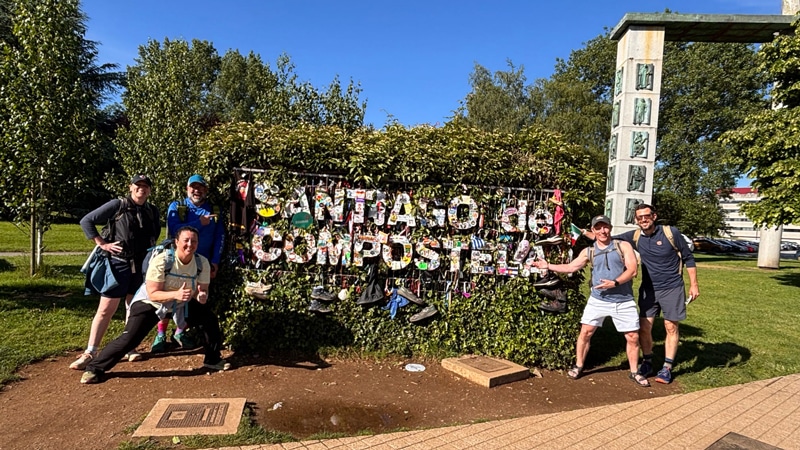
Jess Trahan, Brady Banks, Kris Mares, Wade Langer, and Tony Jeck stand at the entrance to Santiago de Compostela, reflecting on the miles walked and the deeper calling encountered along the way. Photo courtesy of the Rev. Eduardo Bousson
All our journeys are rhapsodies on the theme of discovery. We travel as seekers after answers we cannot find at home, and soon find that a change of climate is easier than a change of heart.
— Phil Cousineau, The Art of Pilgrimage: The Seeker’s Guide to Making Travel Sacred
Last May, I took 10 chaplains and campus ministers on a pilgrimage. We walked the last 72 miles of Spain’s El Camino de Santiago. This is one of the oldest pilgrimages in Christendom. It began in the 9th century with the claim that the remains of St. James were found in a nearby forest. Since then, pilgrims have walked El Camino in search of deeper meaning in their lives.
We began in Sarria, walking the last 115 kilometers of the French Way. The collegiate ministers who joined me were all at a crossroads in their lives. For some, the crossroads was deeply personal. For others, it was professional. They were all looking for clarity on which direction they ought to take. For each of the six days we were on pilgrimage, we walked anywhere between 9 and 19 miles. During that time, we walked together and alone. Sometimes we found the company of strangers who were also pilgrims seeking their own answers. Some of the other pilgrims were religious; some were not. As I visited with people from outside our group, I realized that people involved in this pilgrimage did not see this experience as a magical venture. They understood that being a pilgrim is not about the destination but about the intentionality of seeking clarity to unanswered questions.
One of the questions I was looking for clarity on was regarding my thoughts about faith and God. I wanted to spend time alone and in the company of others to find clarity in the way in which I relate to God in this season of life. On our first day of pilgrimage, I walked next to a stranger who was from Puerto Rico. Of all the people on this pilgrimage, I thought, what are the odds of finding someone from my homeland? As we walked together for the next mile, he shared about where he finds himself in his spiritual life. As he talked about his experience, I felt he was describing mine. As he spoke with joy about his spirituality, I felt joy too and was grateful for the way in which I experience God today.
Pilgrimage is a spiritual journey. We do not need the structure of a physical experience. In truth, we are always in search of clarity. Sometimes we seek clarity regarding our professional life. We need clarity in knowing what to do in certain situations. Sometimes the clarity we seek is for a personal matter. We seek clarity regarding relationships in our lives. We seek clarity about the person we are and the person we want to become.
With every question we ask for clarity, a much deeper truth comes to light. We seek to find a deeper Love because we know that Love is the Way. Ultimately, pilgrimage leads us to Love.
I encourage you to consider the questions for which you seek clarity. Set aside 10 minutes every day to venture on a pilgrimage. Be intentional about keeping this time. Some days you will want to have your pilgrimage alone. Other days, you will want a partner to accompany you on your pilgrimage. Consider these questions as your guide in your quest for clarity;
Where am I now? Where do I want to be?
How is it with my soul?
As I consider my crossroads, is there a third option in which harm to myself or to others can be averted? How long am I able to wait for that third option?
In this pilgrimage, is my love growing or is it stagnant?
Prayer
God of the Way, you are always on the move. You move with us and in us. As I seek clarity for the questions I hold, show me the way. Remind me always that the best option is love. Amen.

Rev. Eduardo Bousson
Senior Manager, Collegiate Ministries
The General Board of Higher Education and Ministry
The United Methodist Church
Related Posts

Methodism has a long history with the concept of perfection. In 18th-century England, perfection or perfectionism was understood the same way it is today. Perfection meant something without error or blemish. John and Charles Wesley, and the early leaders of the Methodist movement, understood perfection differently. In their practice, perfection was related to the Greek term teleio, which conveys maturity, wholeness, and completion.
Sometimes, the road to Damascus passes through Breezewood, Pennsylvania. There at the intersection of Interstates 70 and 76, the Rev. Bruce Maxwell, a United Methodist deacon who serves as an endorsed chaplain at the travel plaza, cares for truckers, travelers, or anyone passing through.
The EXPLORATION discernment event is unlike any other event with its goal of helping people discern and not pushing them into ordained ministry or into a particular form of Christian service. EXPLORATION helps participants discern and be open to what God may be asking of them and how they are called to use their gifts and graces to make disciples of Jesus Christ for the transformation of the world.