Called to Serve: Rev. Joaquin Garcia’s Ministry Shaped by a Lifetime Response to Need
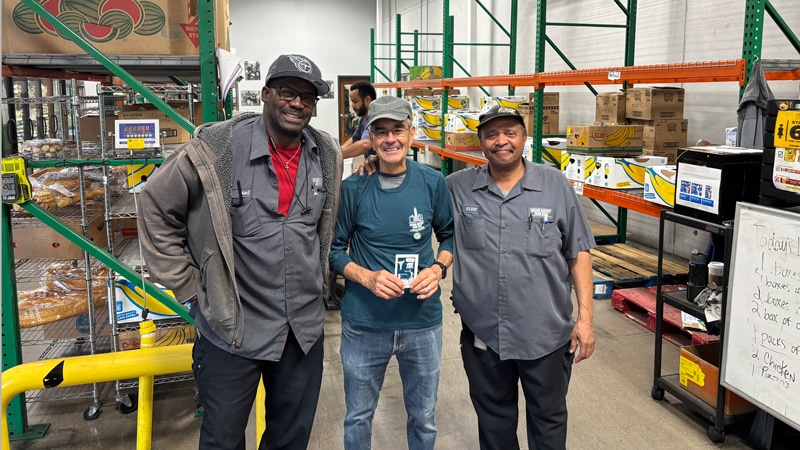
Deacon Rev. Joaquin Garcia (center) volunteers at Second Harvest Food Bank, which serves Middle Tennessee nourishing and empowering People so they can thrive. Photo courtesy of Rev. Joaquin Garcia
By Wendy R. Cromwell
For the Rev. Joaquin Garcia, the call to ministry has never been about a title, position, or appointment. It has always been about responding to need.
“Ministry is essentially a response to real needs,” Garcia said, a conviction that has guided his life for decades. Another lesson he carries came from a former church leader who reminded him, “There is enough need in the world to go around.”
Those words have shaped his understanding of ministry and sustained his commitment to service across more than 60 years. As The United Methodist Church marks the 30th anniversary of the Order of Deacons, Garcia, a founding deacon, sees that calling as central to the identity of deacons. Their role, he said, is to connect the church to the needs of the world and the world to the gifts of the church.
“The ministry of the deacon is to gather the gifts of the church and take them to the world, and at the same time gather the needs of the world and bring them to the church,” Garcia said.
That understanding was forged long before the Order of Deacons was established in 1996. Born in Monterrey, Mexico, Garcia grew up in the Methodist Church, where serving others was part of family life. His mother was active in mission work and often took him to ministries serving people with limited resources.
“Growing up, we had to be involved with the mission site the church sponsored,” Garcia said. “I was exposed to people who didn’t have that many resources.”
Although church leaders encouraged him to explore pastoral ministry, Garcia quickly realized his calling lay elsewhere. After studying business administration, he found himself drawn not to the pulpit but to ministries of education, service, and community engagement.
“As I was finishing my degree, I realized that my desires were to serve in the church,” he said. “Not as a pastor, but to serve in the church.”
That call led him and his wife, Barbara, also a deacon, into a lifetime of ministry in Mexico and the United States. It also positioned him to help shape the evolution of diaconal ministry and witness the birth of the Order of Deacons.
Today, that sense of vocation remains as strong as ever. Even in retirement, Garcia continues volunteering with Community Care Fellowship, a day shelter for people experiencing homelessness in Nashville, and with Second Harvest Food Bank. He sees both ministries as extensions of the same call that first took root in childhood.
“I need to go to Community Care Fellowship twice a week. I need to go to the food bank twice a week,” Garcia said. “Because I live in a bubble, I need to be with humanity.”
Thirty years after the Order of Deacons was established, Garcia believes its purpose remains unchanged: to notice need, respond with compassion, and bring the church into a closer relationship with the people it serves.
“We were called to serve,” he said. “Regardless of legislation, regardless of structures. Ministry is a response to real needs.”
Bridging Church and World
Through diverse ministries and shared purpose, meet six deacons who embody a calling rooted in Word, service, compassion, and justice. Their stories in the coming weeks mark the 30th anniversary of the Order of Deacons and its enduring mission to build bridges of hope.
Related Posts

The proposal to unify four general agencies of The United Methodist Church — Discipleship Ministries, Global Ministries (GBGM), Higher Education and Ministry (GBHEM), and United Methodist Communications (UMCom) — to create a new connectional ministries agency has passed its next significant milestone.

I had one of the most beautiful experiences at an Albergue. On El Camino de Santiago there are many opportunities to stop. Albergues are inns, places where people can stop for the night and rest. Some albergues offer different amenities during the day. Some serve as cafes, places where you can have a bite to eat, use the restroom, and refill your water bottle. Most of them would charge a euro to use the restroom. Some would not allow you to use the facilities unless you were a customer.

Facing ongoing global instability, the boards of Higher Education and Ministry and Global Ministries invest in strengthening mission and ministry, prepare for organizational change, and affirm a vision of hope.