Thirty Years On, United Methodist Deacons Continue to Bridge Church and World
By Wendy R. Cromwell
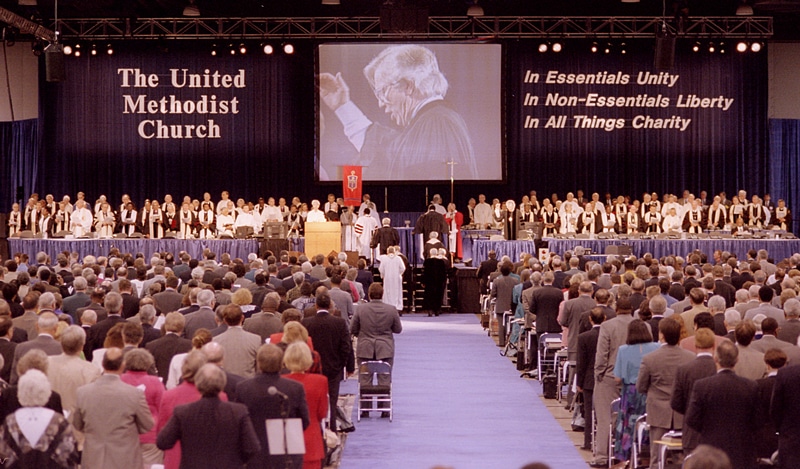
Thirty years after The United Methodist Church established the Order of Deacons, the vocation continues to shape how the church serves beyond its walls through its estimated 1,100 ordained members. Approved by the 1996 General Conference, the order created a permanent ordained ministry centered on Word, service, compassion, and justice, affirming a lifelong calling distinct from elder ministry.
“The ordination expanded the church’s understanding, the richness and the diversity in the many, many ways that God calls people into ministry,” said the Rev. Meg Lassiat, deacon and executive director of ministry at the General Board of Higher Education and Ministry.
For the Rev. Dr. Margaret Ann Crain, ordained in the first class of deacons in 1997, the decision finally named and affirmed a ministry that had long existed.
“The identity of the deacon must always remain focused outward,” Crain said. “Everything I did needed to be focused on equipping the church … for the work of compassion and justice in the world.”
That outward focus remains a defining characteristic of the order. Deacons serve in congregations, schools, nonprofits, hospitals, community organizations, and advocacy ministries, helping connect faith with everyday life.
Few describe that role more clearly than the Rev. Joaquin Garcia, who helped shape the legislation that created the order. Garcia says the deacon’s calling is fundamentally one of connection.
“The ministry of the deacon is to gather the gifts of the church and take them to the world,” Garcia said. “And at the same time, to gather the needs of the world and bring them to the church.”
Garcia believes that ministry begins with attentiveness to human need. “Ministry is essentially a response to real needs,” he said, adding that those needs must be discerned through “prayerfully reading the signs of the time.”
For the Rev. Dr. Cynthia Wilson, that call has been lived through music and worship ministries that have taken her across cultures and communities.
“I’ve always understood my call to service, particularly as it relates to worship and music,” Wilson said. “The real crowning moment for me were the three words: service, compassion, justice. Because that’s what we do. That’s who we are.”
The church’s decision in 1996 affirmed the importance of ministries often carried out beyond traditional church settings, said the Rev. Vicki Walker, a member of the first class of ordained deacons.
“It felt like an acknowledgment that ministries of love, and service, and justice, and compassion were also important,” Walker said. “I was never about preserving an entity as much as I was finding a place to serve that connected church and world.”
Over three decades, the order has expanded far beyond its early associations with education and church-based ministries. The Rev. Amie Stewart, a deacon and senior manager for conference relations at the General Board of Higher Education and Ministry, sees that growth as one of the order’s greatest contributions.
“It’s really blossomed into all sorts of outreach, ministries of compassion and justice,” Stewart said. “It’s almost enlivened the imagination of what the church can be.”
That growing understanding of the diaconate is evident across generations of deacons. “I think that The United Methodist Church has done well at beginning and growing in knowledge of the unique order of the deacon’s calling,” said the Rev. Jacob Penvose, who was ordained this year. “It helps me to understand the role and the work of a deacon in serving others and helping to bridge the world with the church and the church with the world.”
As the church looks ahead, leaders say the need for that connecting ministry is only growing. The Rev. Sharon Rubey believes the order’s purpose remains as vital today as it was 30 years ago.
“We need those who bridge the gap between the church and the world,” Rubey said, “who can stand at that threshold, connect people across differences, and show what God’s love looks like in real, everyday life.”
Bridging Church and World
Through diverse ministries and shared purpose, meet six deacons who embody a calling rooted in Word, service, compassion, and justice. Their stories in the coming weeks mark the 30th anniversary of the Order of Deacons and its enduring mission to build bridges of hope.
Related Posts

As of late September 2026, This Moment Matters has disbursed $38.6 million across 681 grants in the areas of agriculture and food security, education, health, migration, and peace.

A diverse group of church leaders will help guide worship and reflection at EXPLORATION 2026, Nov. 6-8 in Orlando, Florida. Participants will hear from the Rev. Lisa Yebuah, the Rev. Dr. Ashlee Alley Crawford, Bishop Carlo A. Rapanut, and the Rev. Albarka Abbo Wakili, whose ministries span church planting, discipleship, episcopal leadership, and global mission.
When I talk to young people about peacemaking, I hear their cynicism. They’ve told me, “Why bother?” They seem to think no one is trying.