Monday Reflections: A view from the mountaintop
“When it is dark enough, you can see the stars.”
— The Rev. Dr. Martin Luther King Jr., I’ve been to the Mountaintop
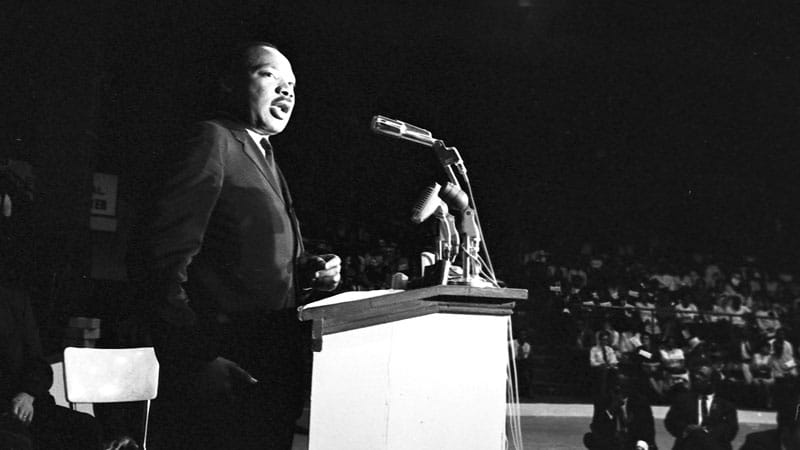
For me, our students are my source for hope. They are the ones I see when I climb the proverbial “Mountaintop.” (The Rev. Dr. Martin Luther King Jr. Photo: the Ken Thompson Collection, General Board of Global Ministries)
Monday was Martin Luther King Jr.’s birthday. He was born in 1929, which would have made him 97 years old today. We remember him as a leader and a prophet. I often wonder what he would say today about the state of our world. Oddly enough, I think we know what his thoughts would be.
In his last sermon, I’ve been to the Mountaintop, he begins with a question, “What period in history would I like to live in?” He accounts for different periods of time and the advances we have made as humanity, but he insists that his time, 1968, is the time he would rather live in. He saw an awakening in the hearts of Americans, African Americans, and people of all other races to make things right. His nonviolent movement was fueled by love and sustained by their faith. Acknowledging the struggle they were suffering, he reflected, “When it is dark enough, you can see the stars.”
This last sermon of his, preached the day before his assassination, is the most consequential for us today. When we think of our BIPOC students, first-generation students, LGBTQ+ students, Pell Grant students, DREAM Act students, and other underrepresented students, we know how difficult these times are for them. Their strife, and the strife of all our students, are those stars that shine “when it is dark enough.”
For me, our students are my source for hope. They are the ones I see when I climb the proverbial “Mountaintop.” Our work in campus ministry is hard. But we do it because we are equipping those who spread hope beyond the campus.
Next month is the 100th anniversary of Black History Month. Regardless of the political environment, I encourage you to celebrate it on your campus. It does not have to be expressed with big events. Here are some small ways you can celebrate it.
When darkness falls in our lives, may we have the wisdom to look up. That is where we can see the stars.

Rev. Eduardo Bousson
Senior Manager, Collegiate Ministries
The General Board of Higher Education and Ministry
The United Methodist Church
Related Posts

Methodism has a long history with the concept of perfection. In 18th-century England, perfection or perfectionism was understood the same way it is today. Perfection meant something without error or blemish. John and Charles Wesley, and the early leaders of the Methodist movement, understood perfection differently. In their practice, perfection was related to the Greek term teleio, which conveys maturity, wholeness, and completion.
Sometimes, the road to Damascus passes through Breezewood, Pennsylvania. There at the intersection of Interstates 70 and 76, the Rev. Bruce Maxwell, a United Methodist deacon who serves as an endorsed chaplain at the travel plaza, cares for truckers, travelers, or anyone passing through.
The EXPLORATION discernment event is unlike any other event with its goal of helping people discern and not pushing them into ordained ministry or into a particular form of Christian service. EXPLORATION helps participants discern and be open to what God may be asking of them and how they are called to use their gifts and graces to make disciples of Jesus Christ for the transformation of the world.