Lenten Reflections 2026: The Rev. Eric Doolittle
Leading students to see with new eyes
By Wendy R. Cromwell
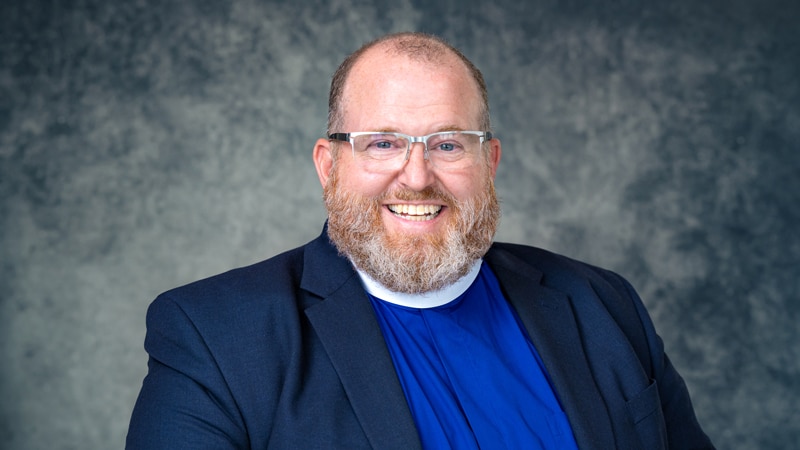
As the chaplain and director of the Kay Spiritual Life Center at American University in Washington, D.C., the Rev. Eric Doolittle approaches campus ministry with the same spirit that Lent invites: a season of looking again, slowing down, and seeing the world anew.
For him, hope often emerges in small, transformative moments. “The ‘Oh! I get it!’ after the theological wrestling. The ‘Thanks for listening,’ after the frantic tears. The ‘I think I’m going to go for it,’ after the doubts and fears,” he said.
Watching students move from uncertainty to clarity reminds him that renewal is always possible. “Seeing students struggle and worry their way through these transformative years to places of thriving and fulfillment gives me hope for those to come and for all of us still on a journey of discovery.”
Doolittle, an ordained elder from the Holston Conference, carries with him the grounding of his Appalachian roots. “My home is Appalachia, specifically the Smoky Mountains of East Tennessee,” he said. A lifelong United Methodist, he studied at Illinois Wesleyan University before attending Wesley Theological Seminary. Ordained in 2009, he began chaplaincy work as early as 2006 and joined American University in 2024.
His campus joy often springs from witnessing others act with courage and conscience. “Watching things happen without me,” he said, describing scenes like students protesting with crucifixes, hijabs and kippots side‑by‑side, or staff making the chapel more accessible “because everyone should feel welcome.” These moments echo Lent’s call to see community with fresh eyes – recognizing grace in places where people show up for one another.
Ministry, for Doolittle, is often as simple and profound as presence. “I tell people that my job is mostly drinking coffee and talking to people,” he said. A former AU chaplain called it “loitering with intent,” a practice that mirrors the Lenten discipline of attentiveness – being available when someone finally says, “I’ve been meaning to talk to you.”
Leading a progressive campus during anxious times brings challenges. “My big challenge has been building trust as people watch to see that what I say matches what I do and that both of those things line up with the love of Jesus,” he said.
He invites the church to look again, to see young people, and the church’s future, with renewed vision. “If you want to see the church of tomorrow, visit a campus ministry today.”
Related Posts

As of late September 2026, This Moment Matters has disbursed $38.6 million across 681 grants in the areas of agriculture and food security, education, health, migration, and peace.

A diverse group of church leaders will help guide worship and reflection at EXPLORATION 2026, Nov. 6-8 in Orlando, Florida. Participants will hear from the Rev. Lisa Yebuah, the Rev. Dr. Ashlee Alley Crawford, Bishop Carlo A. Rapanut, and the Rev. Albarka Abbo Wakili, whose ministries span church planting, discipleship, episcopal leadership, and global mission.
When I talk to young people about peacemaking, I hear their cynicism. They’ve told me, “Why bother?” They seem to think no one is trying.