Juneteenth Observation at NAAMSCU Meeting Calls for Justice, Equity and Truth-Telling
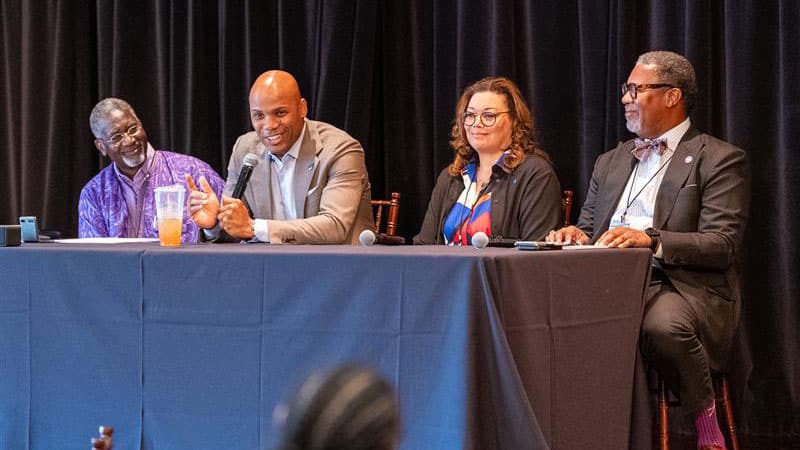
Panel members discuss campus celebrations during Juneteenth Panel at NAAMSCU/University Senate Joint Meeting on June 19. Photo by Adam Bowers
DETROIT — Leaders from United Methodist-related institutions, including seminaries and Historically Black Colleges and Universities called for justice, historical reckoning, and a renewed commitment to equity in higher education and society during a Juneteenth panel discussion at the annual joint University Senate and North American Association of Methodist Schools, College and Universities meeting on June 19 in Detroit, Michigan.
The Rev. Dr. Lee Butler, president of Iliff School of Theology in Colorado traced the historical journey of Juneteenth from the 1770 Boston Massacre to July 5, 1852, when Frederick Douglass lamented, “Your high independence only reveals the immeasurable distance between us.” Rev. Butler emphasized Juneteenth as a response to delayed justice: “The Confederacy did not yield…until June 19, 1865 (in Galveston, Texas). Juneteenth commemorates total emancipation.”
Dr. Monique Guillory, president of Dillard University, urged context when celebrating Juneteenth. “Celebrate everything, but understand the context… There is a spirit that we invoke in this country, that is our diversity, which will not be dismantled, no matter what anyone says.”
Dr. Herman Felton Jr., president of Wiley University, said “Juneteenth means everything. Opal Lee, the grandmother and godmother of Juneteenth is a graduate of Wiley University. To go to Galveston is to understand the connections and the intersections of both my story and my purpose. It’s just incredible, and so what it means to me is everything.”
The Rev. Dr. Lester McCorn, president of Paine College, said Juneteenth is a day of reckoning. “The reason we’re in the place we’re in right now, is because there are a bunch of people in power who are setting policies and practices that want to erase history.”
It is important to tell the whole story — the complete American History. “No one dies from being told the truth,” Dr. Felton said. “It may be uncomfortable. It is uncomfortable for me, but it is what it is.”
“Juneteenth is a marker in the ongoing struggle for justice,” Rev. Dr. McCorn said. “The fact that we have to use a word like emancipation, do you realize how crazy that word is? What human being has the power to set another human being free?”
The panel concluded with a call to center Juneteenth not as a one-day celebration, but as a season of remembrance and action. “We are clearly in a moment where we must display courageous leadership,” Dr. Guillory declared, “Leaning into joy is resistance…But the work remains.”
Juneteenth observations at the joint meeting concluded with worship with Bishop Gregory Palmer, preaching and a celebratory dinner, honoring African American presidents and senators: Dr. Guillory; Dr. Felton; the Rev. Dale Caldwell, president of Centenary University in New Jersey; the Rev. Valerie Bridgeton of Methodist Theological School in Ohio, President James Hildreth of Meharry Medical College in Tennessee and the Rev. Dr. Butler.
Related Posts

Methodism has a long history with the concept of perfection. In 18th-century England, perfection or perfectionism was understood the same way it is today. Perfection meant something without error or blemish. John and Charles Wesley, and the early leaders of the Methodist movement, understood perfection differently. In their practice, perfection was related to the Greek term teleio, which conveys maturity, wholeness, and completion.
Sometimes, the road to Damascus passes through Breezewood, Pennsylvania. There at the intersection of Interstates 70 and 76, the Rev. Bruce Maxwell, a United Methodist deacon who serves as an endorsed chaplain at the travel plaza, cares for truckers, travelers, or anyone passing through.
The EXPLORATION discernment event is unlike any other event with its goal of helping people discern and not pushing them into ordained ministry or into a particular form of Christian service. EXPLORATION helps participants discern and be open to what God may be asking of them and how they are called to use their gifts and graces to make disciples of Jesus Christ for the transformation of the world.