MTSE Hosts Annual Meeting to Advance Leadership and Connection within Methodism
The Methodist-related Theological Schools in Europe (MTSE) met in England as part of a cluster of activities to celebrate the Wesleyan tradition in education, including a gathering of representatives from The United Methodist Church and The Methodist Church in Britain to mark the 50th anniversary of their 1968 concordat, an affirmation of the relationship between the two denominations.
At this meeting, MTSE elected its new officers: president, Rev. Dr. Janet Unsworth, principal of Edgehill Theological College in Belfast, Ireland; vice-president, Dr. Geordan Hammond, director of the Wesley Research Centre in Manchester, England; and secretary, Dr. Michael Nausner. The association was very appreciative of the work of the outgoing MTSE president, Rev. Samuel McBratney, who now holds a leadership position in the Susanna Wesley Foundation in London, England.
The General Board of Higher Education and Ministry (GBHEM), the leadership development agency of The United Methodist Church, has supported MTSE since its beginning and is an important force behind the development of the association and its continued success as leadership opportunities and global connections continue to grow within related church organizations.
“MTSE is an important initiative bringing together 20 institutions today, and the August 2018 meeting was pivotal as we assess leadership plans for the future,” said Dr. Amos Nascimento, associate general secretary, Office of Global Education and New Initiatives, GBHEM.
Rev. Shannon Conklin-Miller, assistant general secretary for Clergy Formation, GBHEM, reflected on the leadership transition, noting that “there are many women among the leadership of theological institutions in Europe, and these institutions are also increasing the opportunities for students to collaborate.” This trend is furthermore reflected in the election of MTSE officers, including Unsworth, who is also a member of the International Association of Methodist Schools, Colleges, and Universities (IAMSCU) Board of Directors.
Historical Growth
Originally named The United Methodist Theological Schools in Europe (UMTSE), the association was developed in 1989 with the fall of the Berlin Wall and the opening of the Iron Curtain. GBHEM leaders, including Revs. Robert Kohler, Ken Yamada, Rena Yocom, Amos Nascimento and Shannon Conklin-Miller, and bishops Patrick Streiff and Rosemarie Wenner, have been very involved with MTSE.
Over the years, the association expanded its membership beyond United Methodists to include Methodist Churches in Britain, Portugal and Italy, as well as Wesleyans and Nazarenes. As a result, the association is robust and has the capacity to:
- focus on academic and theological reflection
- host a student program
- promote research
- support institutional development
Leading up to the meeting, Dr. Michael Nausner, GBHEM LEaD Hub director in Europe and MTSE secretary, prepared a history and statement of purpose, “Connections After the Fall of the Wall,” on behalf of MTSE and supported by GBHEM. This document provides an in-depth historical overview of MTSE.
Global Connections
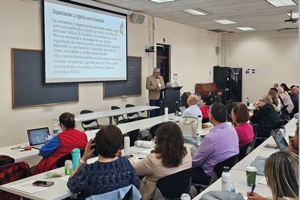
The MTSE meeting also included a joint session with the International Association of Methodist-related Schools, Colleges, and Universities (IAMSCU). This joint meeting furthered the partnership among these international organizations. Participants attended a session on “Methodist Education in England, Europe, and Beyond,” as well as visited various Methodist-related institutions, including Southlands College – University of Roehampton, Methodist Archives at Oxford Brookes, and Wesley House in Cambridge.
To learn more about MTSE and GBHEM’s global initiatives, visit GBHEM.org.
About GBHEM: As the leadership development agency of The United Methodist Church, the General Board of Higher Education and Ministry’s mission is to build capacity for United Methodist lay and clergy leaders to discover, claim and flourish in Christ’s calling in their lives, by creating connections and providing resources to aid in recruitment, education, professional development and spiritual formation. Every elder, deacon and licensed local pastor benefits from our training and candidacy programs. Many young adults find help in clarifying their vocation and God’s call in their lives through our leadership and discernment programs. Follow us on Twitter and Facebook: @GBHEM.
Related Posts

When I talk to young people about peacemaking, I hear their cynicism. They’ve told me, “Why bother?” They seem to think no one is trying.

The proposal to unify four general agencies of The United Methodist Church — Discipleship Ministries, Global Ministries (GBGM), Higher Education and Ministry (GBHEM), and United Methodist Communications (UMCom) — to create a new connectional ministries agency has passed its next significant milestone.

I had one of the most beautiful experiences at an Albergue. On El Camino de Santiago there are many opportunities to stop. Albergues are inns, places where people can stop for the night and rest. Some albergues offer different amenities during the day. Some serve as cafes, places where you can have a bite to eat, use the restroom, and refill your water bottle. Most of them would charge a euro to use the restroom. Some would not allow you to use the facilities unless you were a customer.