Monday Reflections: Practice a Ministry of Presence
“Jesus said: ‘This is what the kingdom of God is like. A man scatters seed on the ground. Night and day, whether he sleeps or gets up, the seed sprouts and grows, though he does not know how. All by itself the soil produces grain—first the stalk, then the head, then the full kernel in the head. As soon as the grain is ripe, he puts the sickle to it, because the harvest has come.'”
— Mark 4:26–29 (NIV)
Photo by Zoshua Colah on Unsplash.com
By the Rev. Dr. Jonathan Acord
Nearly eight years ago, I met a young man who would become an important part of my life. He was a first-generation college student with dreams of becoming a professional basketball player. At first, he was quiet and distrustful. He spoke only when directly asked a question, and even then, his answers were brief. He remained guarded.
Over the next two years, however, the fruit of our relationship began to appear. He started coming to the parsonage to spend time with my family, do laundry, get help with homework, share dinner, and watch ballgames. In time, he began attending church with us and asking questions about Jesus. Through those ordinary moments, he became family.
Eventually, he transferred to another college, and I was appointed to a new ministry setting. Yet we remained connected by phone. When I struggled to connect with students at my new college, I asked him during one of our conversations, “How did we become so close? What did I do that helped you trust me enough to let me speak into your life?”
He replied, “Every time I looked up, you were there. So, I figured if you were always around, I could trust you.”
His response taught me about the ministry of presence. Fruit does not always come from a complex strategy. Spiritual growth does not always require delivering the most polished sermon, creating the most elaborate program, supplying every answer, or leading the most powerful worship service. Sometimes the holy work of sowing is simply showing up.
There is a fitting image in creation. Psalm 100:3 reminds us that we are the sheep of God’s pasture. Sheep eat plants and fruit, and some large, hard seeds survive the process of chewing and are spit back onto the ground. In their ordinary movement through the pasture, sheep can help scatter seeds that later take root in new soil.
Likewise, when we “ruminate” on God’s Word and remain faithfully present in our communities, we may scatter seeds of the kingdom without even realizing it. A conversation, a shared meal, a ride home, help with homework, a listening ear, or a consistent welcome may become the soil in which God brings new life.
Practice a ministry of presence. Be a seed-spitting Christian. Trust God with the mystery of growth and the promise of harvest. As Paul wrote, “I planted the seed, Apollos watered it, but God has been making it grow.” – 1 Corinthians 3:6 (NIV)
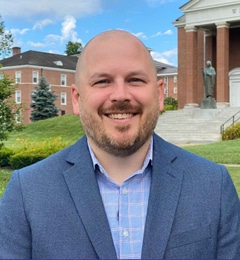
Rev. Dr. Jonathan Acord
The Rev. Dr. Jonathan Acord is a local pastor in the West Virginia Conference of The United Methodist Church. He serves as the vice president of religious & spiritual life and dean of the chapel at West Virginia Wesleyan College. He is a 2023 graduate of United Theological Seminary with a Master of Ministry. He also holds a Master of Physical Therapy, which he earned from West Virginia University in 2004. Acord is married with two adult children, both of whom attend West Virginia Wesleyan College.
Related Posts

Practice a ministry of presence. Be a seed-spitting Christian. Trust God with the mystery of growth and the promise of harvest. As Paul wrote, “I planted the seed, Apollos watered it, but God has been making it grow.” – 1 Corinthians 3:6 (NIV)

In 2016, Doug Abrams brought together two of the world’s most admired religious leaders, Desmond Tutu and the Dalai Lama. The meeting was a celebration of the two men’s decades long friendship. It was also an opportunity to witness their conversations about life and the nature of joy. The result of this meeting is The Book of Joy.
I love poetry. Many times, I have found verses speak to me in deep and transforming ways. A poem, like a painting, can negotiate the in-breaking of what is eternal into our daily lives. Irish poet and philosopher, David Whyte, believes that a single line of poetry can contain a truth that changes a life.