Monday Reflections: Incarnation
“For me, the Incarnation is the place, if you will, where hope contends with fear.”
— Kathleen Norris, “Amazing Grace”

Photo: Tom Barrett/Unsplash
I remember when my kids were little. People would look at my son and say, “He is a mini-Eduardo!” or my daughter, “She’s a mini-Karen!” As they grew, their mannerisms, speech, and even the way they saw the world resembled that of their parents. Whenever I heard those comments, I felt proud; after all, people made them as compliments. I also felt uneasy. I don’t want our children to look like me. I want them to be their own persons and be better than what their parents have become.
Adopting mannerisms, values, and practices is a form of incarnation. Incarnation is being in someone else’s flesh. In the Christian tradition, when we speak of the Incarnation, we speak of the mystery of God becoming like one of us. In the quote above, Kathleen Norris speaks of the incarnation as the place where hope contends with fear. For her, when God became flesh, God brought hope to the human experience. In the Christian life, because of the Incarnation, we can choose hope over fear. Hope is always available. When fear becomes less than useful, we can choose hope instead.
Later, Norris describes hope in this way: “Even in terrible circumstances and calamities, in matters of life and death, if I sense that I am in the shadow of God, I find light, so much light that my vision improves dramatically.” Hope improves how we see.
In the Incarnation, God offers light in the darkest places. The words of Jesus are an example of this light. In the gospel of Luke chapter 4, verses18-19, he declares,
“The Spirit of the Lord is upon me,
because he has anointed me
to bring good news to the poor.
He has sent me to proclaim release to the captives
and recovery of sight to the blind,
to set free those who are oppressed,
to proclaim the year of the Lord’s favor.”
This is hope and light. When we are sent to make a difference in this world, we are sent to look after those who are hurting the most. We are sent to lead our lives with love. When we participate in that love, the Incarnation ceases to be a mystery and turns into an invitation for us to become.
Prayer
God of light. Sometimes darkness doesn’t allow me to see. Improve my vision so I can see hope. Cast light around me so I may incarnate love. Amen.

Rev. Eduardo Bousson
Senior Manager, Collegiate Ministries
The General Board of Higher Education and Ministry
The United Methodist Church
Related Posts

Rev. Vicki Walker traces her call to ministry to a single, startling moment that would shape the rest of her life. “It was 1980. I was 19 years old,” Walker said. During a quiet retreat, she sat alone in a chapel when she heard a voice she could not ignore. “I sense, I hear this voice that says, ‘I want you to go to seminary, get a master’s in Christian education, and work with youth.’”

Adopting mannerisms, values, and practices is a form of incarnation. Incarnation is being in someone else’s flesh. In the Christian tradition, when we speak of the Incarnation, we speak of the mystery of God becoming like one of us.
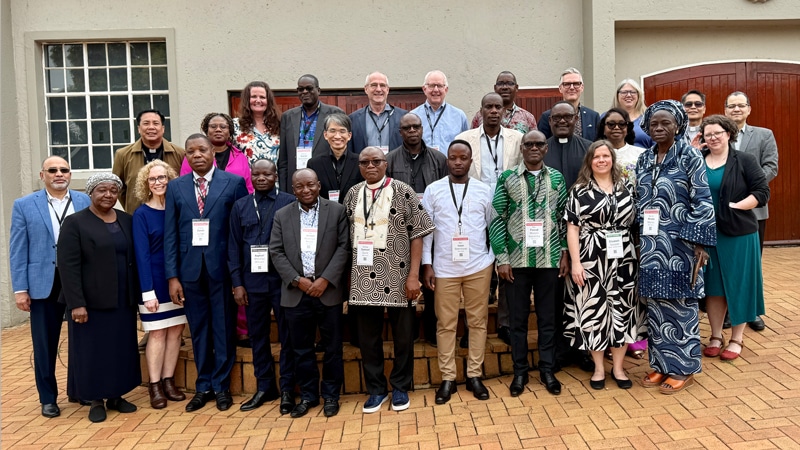
The Central Conference Theological Education Fund (CCTEF) awarded $992,594 in grants to support theological education across The United Methodist Church. During its spring 2026 meeting in Johannesburg, South Africa, commissioners reviewed $3.9 million in funding requests and made awards from a total allocation of $1.03 million. The final grant list was released in August.