Lenten Reflections 2026: The Rev. David Wright
Joy Lives Beyond the Office Walls for Chaplain David Wright

“What inspires hope for me is being present as students bring in new wisdom and critically integrate it with their own spiritual or religious worldview. Seeing creation and creativity persist is always energizing.”
— The Rev. David Wright, Chaplain at University of Puget Sound
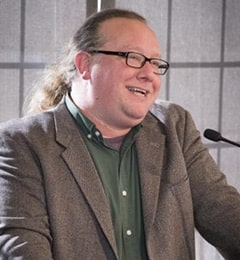 “What inspires hope for me is being present as students bring in new wisdom and critically integrate it with their own spiritual or religious worldview. Seeing creation and creativity persist is always energizing.”
By Wendy R. Cromwell
After nearly 20 years serving as chaplain at the University of Puget Sound, the Rev. David Wright says his greatest source of hope continues to come from the students who fill his days with curiosity, creativity, and an ever‑evolving search for meaning.
“What inspires hope for me is being present as students bring in new wisdom and critically integrate it with their own spiritual or religious worldview,” Wright said. “Seeing creation and creativity persist is always energizing.”
Wright, who grew up in Arizona, attended the University of Puget Sound as an undergraduate before completing his Master of Divinity at Duke University. He was ordained as an elder in the Pacific Northwest Annual Conference in 2003, and just three years later returned to Puget Sound as chaplain – a role he has held ever since.
One of the joys of his work, he said, is stepping out of his office and into the many corners of campus life. “Getting out of my office and spending time in other spaces brings me joy,” Wright said. “It’s in those moments that I get to see the diversity of our community up close.”
Serving a campus community with students from many faith backgrounds, or none at all, is an aspect of chaplaincy he especially cherishes. “My role is to serve those of any, all, or no particular spiritual or religious background,” he said. “It offers me so much space for creativity, learning, and growth – and to be challenged.”
This year, Wright faces a rare transition: eight of his 10 student leaders are graduating at the same time. While he celebrates their success, he acknowledges the shift ahead. “I know graduating and moving on is the point of all this, but it’s going to be a huge transition,” he said.
Still, he’s looking forward to one event in particular. “I’m probably most excited for our Interfaith Baccalaureate Celebration, especially given the strength of my eight graduating seniors and what they will bring to the program,” he said.
If he could share one message with church members about his work, Wright said it would be that campus chaplaincy is often misunderstood. “It’s different from what you might assume,” he said. “And each chaplaincy is different from every other.”
Wright says that if he weren’t serving in ministry, he’d dream of running a combined bookstore, library, coffeeshop, and beer bar – a space for community, conversation, and creativity – much like the campus he has served for nearly two decades.
Related Posts

As of late September 2026, This Moment Matters has disbursed $38.6 million across 681 grants in the areas of agriculture and food security, education, health, migration, and peace.

A diverse group of church leaders will help guide worship and reflection at EXPLORATION 2026, Nov. 6-8 in Orlando, Florida. Participants will hear from the Rev. Lisa Yebuah, the Rev. Dr. Ashlee Alley Crawford, Bishop Carlo A. Rapanut, and the Rev. Albarka Abbo Wakili, whose ministries span church planting, discipleship, episcopal leadership, and global mission.
When I talk to young people about peacemaking, I hear their cynicism. They’ve told me, “Why bother?” They seem to think no one is trying.