Monday Reflections: Benson Nurtures Faith, Formation and Resilience at Duke Divinity

"Working with students is a constant reminder that God is continuing to form and nurture and call amazing people into ministry," said the Rev. Meghan Benson said. (Photo: Kathleen Barry, United Methodist Communications)
Oct. 10, 2025 | By Wendy R. Cromwell

The Rev. Meghan Benson and her family (Photo: Courtesy of Meghan Benson)
The Rev. Meghan Benson, chaplain at Duke Divinity School, has spent nearly two decades walking alongside students as they discern their calls to ministry. Her work centers on leading worship and offering pastoral care to both residential and hybrid students.
"Working with students is a constant reminder that God is continuing to form and nurture and call amazing people into ministry," Benson said. "For all that I hear about the church dying, I get to see way too much evidence to the contrary."
Benson grew up in Colorado Springs, Colorado, and attended Southern Methodist University, where campus ministry shaped her spiritual journey. She arrived at Duke Divinity in 1999 and was ordained in 2009.
"I did not pursue ordination right away," she said. "During this time, my life (gratefully) fell apart, which was what I needed to find my center again."
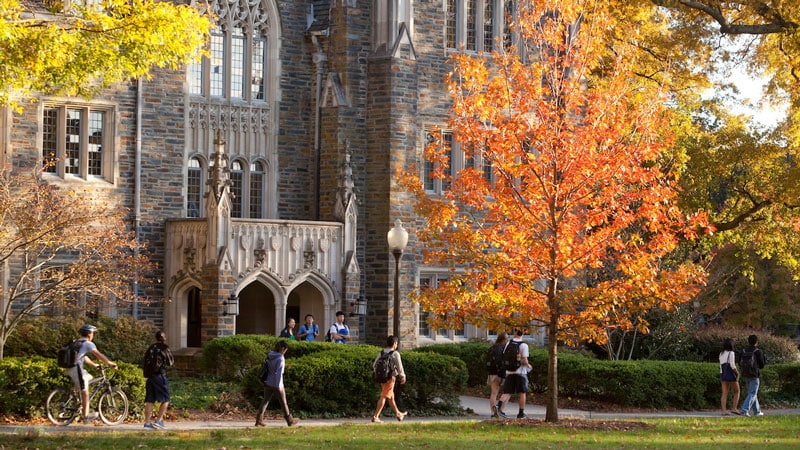
She finds joy in the rhythms of campus life — from cherry blossoms in spring to the carillon's hymns at dusk. "I also really love a great latte and a good conversation with a student," she said.
Despite recent institutional challenges and emotional fatigue, Benson remains deeply committed to her students. "I love engaging with them and the energy they bring. I learn from them, and it is a gift to be able to share some of the things I've learned along the way that may help them on their journeys."
Her approach to chaplaincy emphasizes holistic formation. "Seminary is not only about the heady and intellectual disciplines," Benson said. "It's also about forming patterns of worship, spiritual practices, self-reflection, mentorship and spiritual direction."
Benson is passionate about the role of theological education in the wider university context. "There's a lot of misinformation and fear-baiting around university education these days," she said. "In my context, we are seeking to know truth, to be a place where iron sharpens iron, and to form our students to serve the church and the world."
She points to interdisciplinary partnerships across Duke that expand students' impact, such as with the medical school, the School of the Environment and the School of Public Policy. "All these students seek to live out their faith in meaningful ways in the church or in the public square.
"If I can encourage our students to take the learning seriously but release the idolatry of grade… and invest more deeply into meaningful relationships that will deepen their knowledge of the heart of God, I will have done my job."
Related Posts

This last Sunday, as a guest preacher, I didn’t want to say something that would create a problem for my friend as she was coming back from vacation. This time I felt led to use empathy as the centerpiece of the sermon. Of course, at any other time in history, empathy is the safest thing to talk about in church. Except in our time. Empathy has become a dirty word and controversial even in the church.

When Paul writes to the Philippians, he is aware that his life is unfinished. He knows he still has more to accomplish. He is driven by his mission and his love for others. I know an unfinished life is not the same as an abridged one. They have in common that they are not complete, that there is more to do.

The University Senate of The United Methodist Church has approved a new Framework for United Methodist Formation, establishing a more comprehensive and flexible approach to preparing United Methodist candidates for ministry at approved non-United Methodist theological schools.