Monday Reflections: Remembering our beginnings
“Because it helps us to remember, there is no more powerful force than a people steeped in their history.”
— Lonnie G. Bunch III, 14th Secretary of the Smithsonian
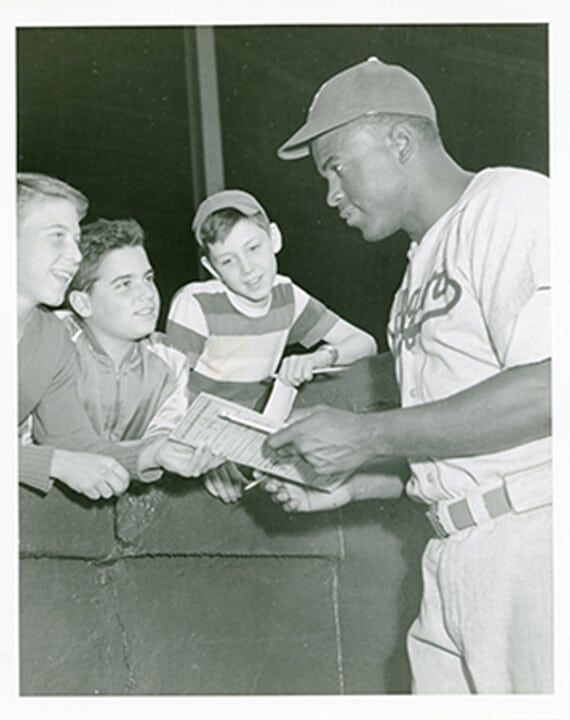
Jackie Robinson became the first African American baseball player in the Major Leagues. … He showcased that African Americans were people of character. Photo courtesy of the National Archives
Today, we begin celebrating Black History Month. The contributions of African Americans to our culture and history are to be celebrated. There are people like George Washington Carver, who, after beginning at Simpson College (now University) and graduating from Iowa State, transformed American agriculture with principles we still use today. With him are educators, artists, civic leaders, scientists, business people, and leaders in every role in society who have made the United States the country it is today.
As a baseball fan, I like to see American history through the lens of the sport. There is no greater example of resiliency than that of Jackie Robinson. After signing with the Brooklyn Dodgers, Robinson had an exceptional career. After baseball, he was a business owner, started housing projects, and founded a bank, but we know him best for what he did in the baseball field. He played for only 11 years. At the time of his retirement, he had recorded a .311 batting average, 137 home runs, 734 runs batted in, and 197 stolen bases. As impressive as that was, he is known better for what he did off the field.
Jackie Robinson became the first African American baseball player in the Major Leagues. At a time when segregation was the law, he was the first American in the racial integration of the United States. He suffered much. His teammates did not want him. When traveling, he had to use different facilities from the rest of the team. He was bullied. But he had the strength to persist. He showcased that African Americans were people of character.
This month, we remember stories like Mr. Robinson’s because they inspire us to be better. They appeal to the better parts of our nature. We look back, we remember, and with the example of those who have come before us, we move toward the future.
In 2021, at the inauguration of Joe Biden, the 46th president of the United States, a 23-year-old Amanda Gorman read her poem The Hill We Climb. In it, she recognizes our nation’s struggles but praises the future we can have together. She writes,
And yes, we are far from polished, far from pristine, but that doesn’t mean we are striving to form a union that is perfect. We are striving to forge our union with purpose, to compose a country committed to all cultures, colors, characters, and conditions of man. And so we lift our gazes not to what stands between us but what stands before us. We close the divide because we know to put our future first.
Deep within faith, after we have taken away all the layers of doctrine and interpretation, after we have peeled all dogma related to our desire for power and stability, after we strip our self-centered pursuits, there is one simple principle: Do unto others as you would like them to do to you. And together with that, one more: Love everyone as God has loved you.
There is no greater law than these. This month, we remember.
Prayer
Lord, help us remember and celebrate the contributions of all African Americans. Give us the courage to remember and celebrate. Give us the courage to love as you have loved us. Amen.

Rev. Eduardo Bousson
Senior Manager, Collegiate Ministries
The General Board of Higher Education and Ministry
The United Methodist Church
Related Posts

I find peace in perspective. I also find strength, particularly when I feel overwhelmed. Perspective helps me understand that what is in front of me need not determine my fate. Japanese poet Nanao Sakaki said it best with his poem, "Break the Mirror."

AUSTIN, Texas — In 2025, Huston-Tillotson University celebrated 150 years of service and transformation, supported in part by the Black College Fund (BCF) of The United Methodist Church (UMC). President Dr. Melva K. Williams said BCF funding has been “transformational” for the private, United Methodist-related Historically Black College and University (HBCU), which does not receive state funding. The university ranks No. 1 among private HBCUs in Texas and No. 15 overall, according to Niche Colleges’ 2026 rankings.

MARSHALL, Texas — The United Methodist Church’s Black College Fund has made an “indelible footprint” on Wiley University, providing steadfast support that President Dr. Herman Felton Jr. says continues to drive student success, modernize the 151‑year‑old campus, and strengthen the institution’s long‑term stability.