Jacob Penvose Bridges Faith and Mental Health Through His Call as a Deacon
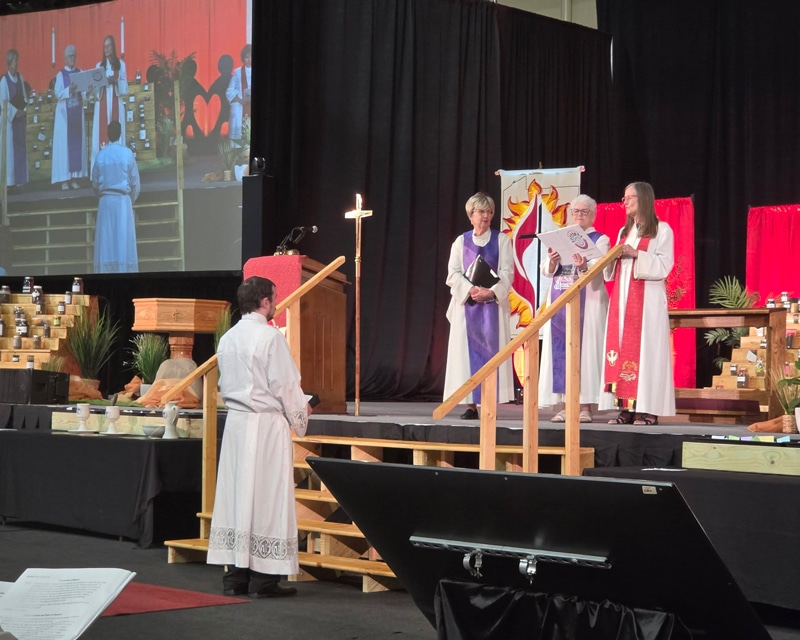
The Rev. Jacob Penvose is ordained as a deacon deacon in full connection from the Western Pennsylvania Annual Conference. Photo courtesy of the Western Pennsylvania Annual Conference.
By Wendy R. Cromwell
“What inspired me to become a deacon is to be able to share the love of God with individuals who may not ever enter the church,” says the Rev. Jacob Penvose, a deacon in full connection from the Western Pennsylvania Annual Conference.
His calling takes shape every day in counseling sessions, conversations with people in crisis, and relationships built far beyond the walls of a sanctuary. Penvose has dedicated his ministry to serving people who often feel disconnected from the church and helping them experience God’s love in tangible ways.
Penvose serves full time with Core Psychiatric and Psychological Services, a community mental health agency, while also serving as senior pastor of three small rural churches. The combination allows him to live out a vocation centered on presence, compassion, and accompaniment.
“I’ve always wanted to be a person who has helped others,” he said. “I love listening to peoples’ concerns. I love being able to walk alongside them in their times of need and trouble.” Working as a mental health therapist has given him the opportunity to do exactly that, supporting individuals through some of their most difficult moments while offering hope and encouragement along the way.
His ministry is shaped by the people he encounters every day, many of whom feel forgotten by religious communities or believe they are somehow beyond God’s reach. Penvose sees his role as helping bridge that divide, creating space for people to experience grace, mercy, and belonging.
“The biggest thing that I have learned from my two calls is that there are still people out in the world that need to experience the love, the grace, and the mercy of God for themselves,” he said. “I have been fortunate enough to be able to help individuals come to know that.”
His understanding of service traces to an early call to ministry during his teenage years. While he initially imagined a future as a pastor, he gradually realized his deepest passion was not leading from the front but serving alongside others. During college and while working in the restaurant industry, he discovered that people naturally sought him out to share their struggles and concerns. Those experiences ultimately led him toward counseling and clarified his unique call to ministry.
“I was meant to be of service and not to lead,” Penvose reflected. That conviction continues to guide his work today and is rooted in the example of Christ’s servant ministry.
Whether he is counseling a client, preaching in one of his congregations, or simply listening to someone who needs support, Penvose believes ministry happens through relationships. His work reminds people that they are seen, valued, and loved by God.
As The United Methodist Church marks the 30th anniversary of the Order of Deacons, Penvose’s ministry offers a living example of the vocation’s enduring purpose: connecting church and community through acts of service, compassion, and faithful presence. As he puts it, deacons are called to help “bridge the world with the church and the church with the world.”
Bridging Church and World
Through diverse ministries and shared purpose, meet six deacons who embody a calling rooted in Word, service, compassion, and justice. Their stories in the coming weeks mark the 30th anniversary of the Order of Deacons and its enduring mission to build bridges of hope.
Related Posts

The proposal to unify four general agencies of The United Methodist Church — Discipleship Ministries, Global Ministries (GBGM), Higher Education and Ministry (GBHEM), and United Methodist Communications (UMCom) — to create a new connectional ministries agency has passed its next significant milestone.

I had one of the most beautiful experiences at an Albergue. On El Camino de Santiago there are many opportunities to stop. Albergues are inns, places where people can stop for the night and rest. Some albergues offer different amenities during the day. Some serve as cafes, places where you can have a bite to eat, use the restroom, and refill your water bottle. Most of them would charge a euro to use the restroom. Some would not allow you to use the facilities unless you were a customer.

Facing ongoing global instability, the boards of Higher Education and Ministry and Global Ministries invest in strengthening mission and ministry, prepare for organizational change, and affirm a vision of hope.