Meet the Scholars: Expanding Education to Protect At-Risk Widows
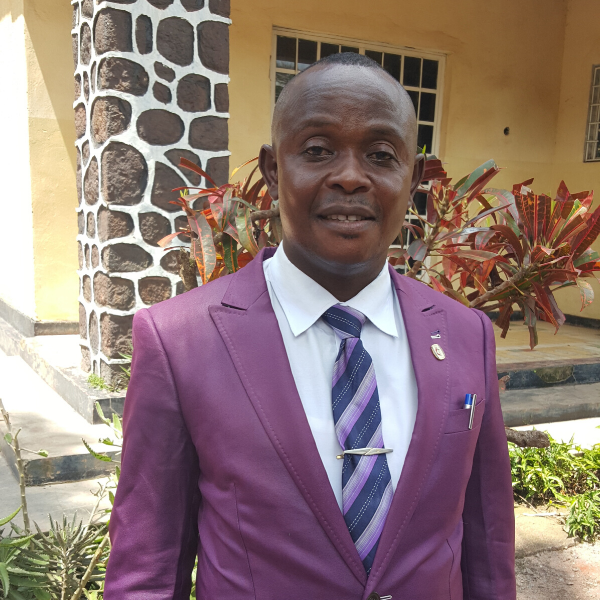
As an expert in pastoral care and counseling, Rev. Mwepu Dikonzo said he felt an “obligation” to continue his education so that he might be better equipped to help his community.
Where he lives in the Kamina region of the Democratic Republic of Congo – and throughout many areas of Sub-Saharan Africa – dangerous widow purification practices are common. Dikonzo hopes to combat them with greater education.
“All the people in my region have always needed and would benefit from more residents who are trained at the graduate level,” he said.
Dikonzo holds a master’s degree in pastoral care and counseling from Africa University and currently serves as a lecturer at Kamina Theological School. In the summer of 2019, he became one of 13 students in the inaugural class of the new joint Ph.D. program between Africa University and Wesley House Cambridge. Earning his Ph.D. will help him expand his work as an educator.
At Kamina Theological School, he teaches students how to better counsel their communities through courses on pastoral care and contemporary theology.
“I advise students who will have to care for or give advice to people facing difficult situations,” he said. “God is with my students and I when we do this work. It fortifies me to know that he is assisting me and that I am able to exercise my faith through my career in this way.”
Dikonzo has been able to help many communities through his students, but he plans to do more with a doctoral degree. He hopes that joining the AU-Wesley program will allow him to teach even more students and inspire others in his community to pursue advanced degrees too. Spreading knowledge and information will be a major focus for Dikonzo as he begins his doctoral research.
He will study ways to break the cycle of violence that is often tied to traditional widow-purification rites in Sub-Saharan Africa. Versions of the purification rite can make widows face sexual assault, forced marriage or unsanitary cleansing rituals. In addition to the immediate physical and mental violence against widows, these practices are also often structured to deprive women of their rights to property and leave many homeless and destitute after the death of their husbands.
“My goal is to get the knowledge to everyone, so that the practice of purification rites is administered without applying violence,” he said. “As the Bible tells us in Hosea 4:6, ‘My people are destroyed for lack of knowledge.’ So, I have to do the research and pass it on to others.”
For Dikonzo, his own education – and each new person he is able to teach as a result of it – is about causing a ripple effect. He sees the AU-Wesley program as a way to form and foster leaders for the Church and its many surrounding communities in Africa.
“This program is important because it trains knowledgeable Church leaders who can pass on what they know to many people,” he said.
About GBHEM: The General Board of Higher Education and Ministry embraces the ministry of learning and leadership formation in The United Methodist Church and the Wesleyan tradition; serving Christians around the world who are shaped by a process of intellectual engagement, spiritual and character formation, and leadership development. We cultivate a dynamic culture of call and vocational discernment that encourages lay and clergy leaders to discover, claim and flourish in God’s ministry and mission for the Church, the academy and the world. Follow us on Twitter and Facebook: @GBHEM.
Related Posts

The University Senate of The United Methodist Church has approved a new Framework for United Methodist Formation, establishing a more comprehensive and flexible approach to preparing United Methodist candidates for ministry at approved non-United Methodist theological schools.

As of late September 2026, This Moment Matters has disbursed $38.6 million across 681 grants in the areas of agriculture and food security, education, health, migration, and peace.

A diverse group of church leaders will help guide worship and reflection at EXPLORATION 2026, Nov. 6-8 in Orlando, Florida. Participants will hear from the Rev. Lisa Yebuah, the Rev. Dr. Ashlee Alley Crawford, Bishop Carlo A. Rapanut, and the Rev. Albarka Abbo Wakili, whose ministries span church planting, discipleship, episcopal leadership, and global mission.