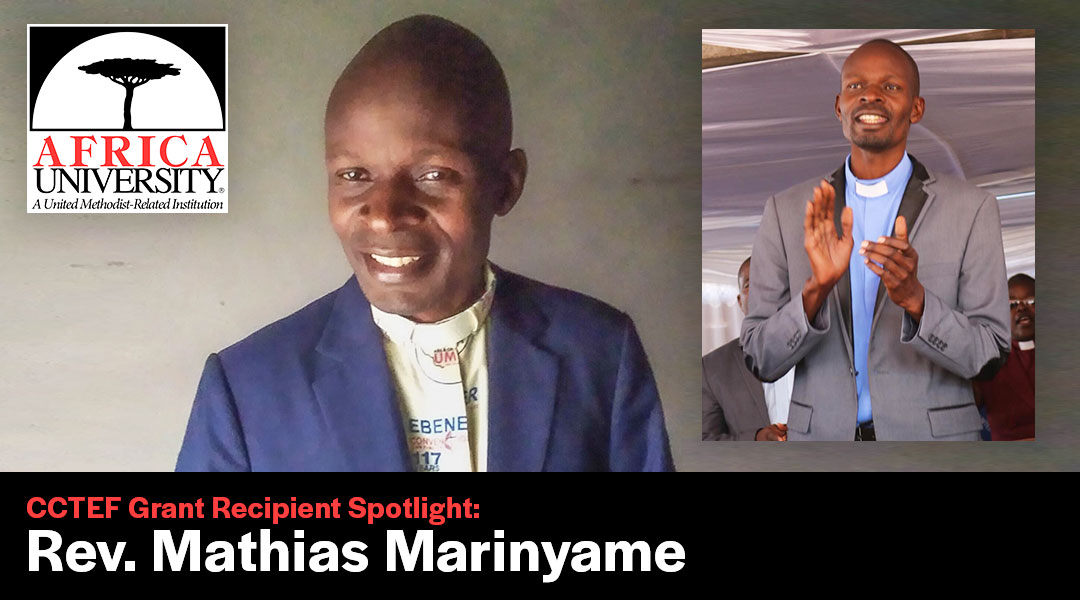
CCTEF Grant Recipient Spotlight: The Rev. Mathias Marinyame
Zimbabwe pastor says access to relevant theological education “transforms ministry,” provides security during COVID-19 pandemic
After completing his undergraduate degree, a Bachelor of Divinity with honors at Africa University in 2009, the Rev. Mathias Marinyame of the Zimbabwe East Annual Conference longed to pursue a master’s degree at the United Methodist institution. Financial challenges, however, blocked his path.
Much like his peers in the Central Conferences, composed of Africa, Europe and the Philippines, obtaining theological education in Zimbabwe can be difficult due to the distance between seminaries, cost, a shortage of well-trained professors, and the availability of resources in needed languages.
A grant from the Central Conference Theological Education Fund helped change that for Marinyame.
“I am now a pastor with a different mindset in the area of pastoral care and counseling,” he said. “I discovered a gap in the way I used to practice ministry. The lectures and intensive research have managed to fill that gap.” Without the grant, Marinyame said, furthering his education would have been out of reach.
Established by the 2012 General Conference of The United Methodist Church, CCTEF grants provide pastors access to valuable theological education through e-learning and an array of resources not otherwise available. The 2016 General Conference approved $10
million from the World Service Fund allowing CCTEF to continue pursuing the goal of strengthening theological education and pastoral formation in the Central Conferences.
In addition to giving Marinyame an opportunity to study at the Institute of Theology and Religious Studies at Africa University, the grant he received has also provided stability in an uncertain time. “The fund also ensured I have full-time accommodation on campus as well as meals. I have access to Wi-Fi for my research, even in my room. Medical health is also cared for by the CCTEF grant, and that gives me a sense of health security, even during this COVID-19 pandemic era,” he said.
This year, Marinyame reached his goal and graduated from Africa University with a master’s degree in religious studies with a focus on pastor care and counseling.
Congratulations, Rev. Marinyame!
Central Conference Theological Education Fund (CCTEF) Grant
The Fund for Central Conference Theological Education was established by the 2012 General Conference of The United Methodist Church (UMC). The UMC continues to live out the Wesleyan vision, to “unite the pair so long disjoined – knowledge and vital piety.” The goal is to strengthen theological education and pastoral formation in all of the Central Conferences in Africa, Europe and the Philippines. Funding plays a crucial role is such efforts.
The General Conference adopted the following categories as appropriate uses for the funding:
- Development of theological schools
- Development of Courses of Study
- Development of libraries and contextually developed resources
- Scholarships and faculty development
- Support for associations and networks of faculty and schools
- Support for new and innovative approaches to theological education
The Commission on Central Conference Theological Education acknowledged and affirmed these categories. Within the guidelines, the Commission states that priority will be given to requests that build capacity and sustainability, develop contextual education and resources and new/ innovative initiatives.
Funding is available for each Central Conference and Episcopal Area within the Central Conferences. The Commission approves the grants on a proportional basis.
Learn more about the Central Conference Theological Education Fund and how to apply here:
Related Posts

Easter! In the Christian tradition, the season of Easter (or Eastertide) begins on Easter Sunday and runs for 50 days ending on the Sunday after Pentecost. For me, this is good news. For the 40 days of Lent, we have been in self-examination, often finding ways in which we fall short. Eastertide is also filled with self-reflection, but as a celebration of who we have become. Eastertide is a celebration of transformation.

Roland Fernandes addresses the Global Ministries and Higher Education and Ministry boards of directors in their spring meeting held in Nairobi, Kenya.

LITTLE ROCK, Ark. — For Philander Smith University President Dr. Maurice Gipson, support from The United Methodist Church, its General Board of Higher Education and Ministry (GBHEM), and the Black College Fund is essential. “I look at those funds as our version of state support,” Gipson said. “Without the support, there would be critical infrastructure activity we’d be unable to do.”