Black College Fund Support Helps Sustain Dillard University’s Mission and Legacy
11 Schools, 1 Calling: How the Black College Fund Sustains Our HBCUs
By Wendy R. Cromwell
NEW ORLEANS — At Dillard University, the Black College Fund (BCF) of The United Methodist Church is doing more than preserving infrastructure — it’s sustaining a legacy of faith-based education and empowerment for historically underserved students at this UM-related university in Louisiana, says Monique Guillory, Dillard’s president.
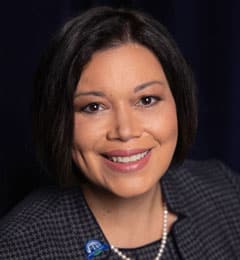
Dr. Monique Guillory, president of Dillard University
“Faith-based education is at the heart of what we do,” said Guillory, who assumed the presidency in December 2024 after serving as interim since May 2024. “We are working to make the world a better place.”
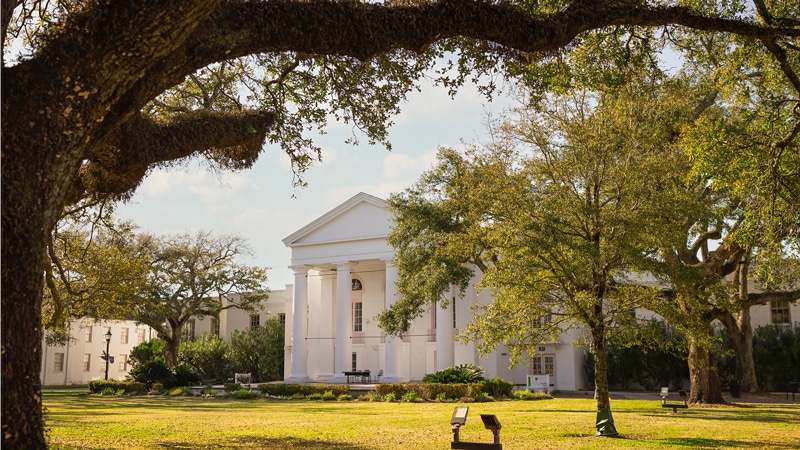
The United Methodist Church’s continued investment through the BCF, administered by the General Board of Higher Education and Ministry (GBHEM), directly supports Dillard’s mission. A prime example is the restoration of Lawless Chapel, the spiritual and communal heart of campus. Damaged by recent hurricanes, the chapel roof, made of hand-crafted ceramic tiles, is being repaired with BCF infrastructure dollars.
“Those BCF capital funds are making a tremendous impact,” Guillory said. “It would not be possible to restore the chapel without the support of The United Methodist Church and the Black College Fund.”
Founded 155 years ago, Dillard University has long stood as a beacon for Black higher education with notable programs in nursing, criminal justice and public health. Guillory emphasizes that faith remains central to the university’s culture. “Our value system is prominent and discussed throughout the whole curriculum. We are more deliberate about it,” she said.
In a post-pandemic era marked by anxiety and global uncertainty, Dillard’s mission is more critical than ever. “Students come with hope, but also anxiety and a sense of powerlessness at the mercy of a constantly shifting future,” Guillory said. “We bring them into our community, nurture them, help them tap into their divine strength which empowers them.”
Scholarships from GBHEM and unrestricted BCF funds allow the university to prioritize needs often overlooked, such as infrastructure maintenance amid New Orleans’ constant climate threats.
The United Methodist Church’s partnership provides financial assistance and spiritual encouragement. “It restores faith in humanity,” Guillory said. “It says the church believes in our mission. That’s very encouraging for a new president.”
Guillory says her university’s partnership with GBHEM is vital — and deeply personal. “We are doing the heavy lifting for society. And we’re doing it with less.”
About the Black College Fund
The United Methodist Church expands access to quality education through the General Board of Higher Education and Ministry and the Black College Fund, supporting 11 affiliated Historically Black Colleges and Universities. As the largest church-based supporter of HBCUs, the fund provides essential resources for capital improvements, innovative programs, operating expenses, and initiatives that strengthen student success and institutional vitality.
Related Posts

Easter! In the Christian tradition, the season of Easter (or Eastertide) begins on Easter Sunday and runs for 50 days ending on the Sunday after Pentecost. For me, this is good news. For the 40 days of Lent, we have been in self-examination, often finding ways in which we fall short. Eastertide is also filled with self-reflection, but as a celebration of who we have become. Eastertide is a celebration of transformation.

Roland Fernandes addresses the Global Ministries and Higher Education and Ministry boards of directors in their spring meeting held in Nairobi, Kenya.

LITTLE ROCK, Ark. — For Philander Smith University President Dr. Maurice Gipson, support from The United Methodist Church, its General Board of Higher Education and Ministry (GBHEM), and the Black College Fund is essential. “I look at those funds as our version of state support,” Gipson said. “Without the support, there would be critical infrastructure activity we’d be unable to do.”